Do AI Translator Devices Actually Work? 2026 Buyer’s Guide
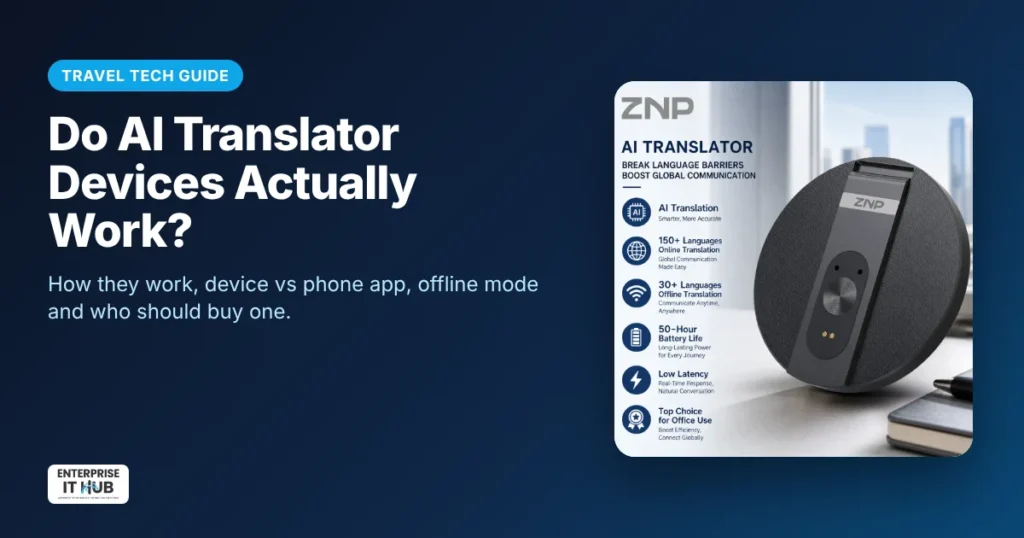
Quick answer: Yes, AI translator devices work well for everyday conversations: ordering food, asking directions, checking into hotels, shopping and simple business chats. The best ones offer real-time two-way translation, support 100+ languages, include offline language packs for travel without data, and can record and transcribe conversations. They’re less reliable with heavy slang, strong accents in noisy places, and legal or medical conversations, where a professional interpreter is still the safer choice.
This guide explains how AI voice translators work, how they compare to a phone app, which features matter, and who gets the most value from one.
How does an AI voice translator work?
You speak, and the device records your voice. Speech recognition turns it into text, an AI model translates it, and the translation is shown and spoken aloud in the other language. Then the other person replies, and the process runs in reverse. Most devices pair with a phone app over Bluetooth and use the phone’s internet connection for the most accurate cloud translation, or switch to offline packs when there’s no signal.
AI translator device vs phone app
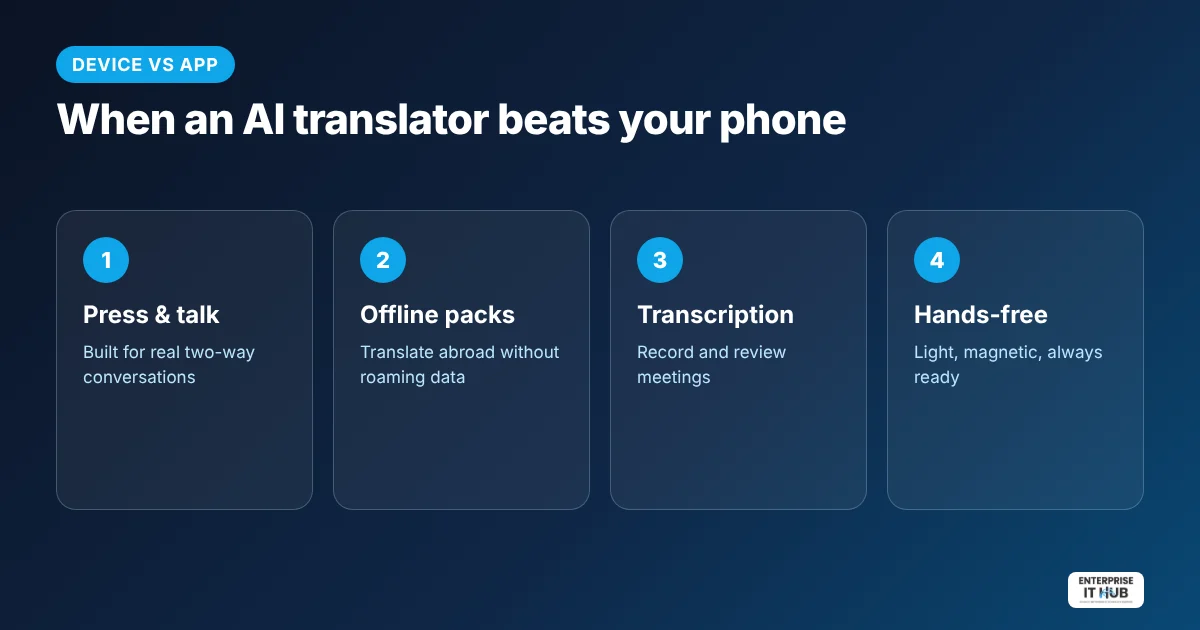
| Dedicated AI translator | Phone translation app | |
|---|---|---|
| Ease of use | Press-and-talk, built for conversations | Unlock the phone, open the app, choose languages |
| Microphone | Designed to pick up speech close by | General-purpose phone mic |
| Hands-free and wearable | Often clips or attaches magnetically | You hold the phone out |
| Meeting recording and transcription | Built-in on many models | Varies by app |
| Cost | One-time device price | Usually free |
A phone app is fine for an occasional sign or menu. A dedicated device is better if you’ll have many spoken conversations, for example on a trip, at work, or with family who speak another language.
Features to look for
1. Two-way real-time translation
Both people should be able to speak naturally, with translation in both directions and very little lag.
2. Language coverage
Check that your exact languages and dialects are supported, for example Spanish (Mexico) vs Spanish (Spain), or Mandarin vs Cantonese.
3. Offline mode
Offline packs keep you translating on a plane, in the subway or abroad without roaming data. They usually cover the most popular languages.
4. Recording and transcription
Useful for meetings, lectures and interviews. You get a written record to review later.
5. Size and battery
Small, light devices are easier to carry all day.
Our pick
The magnetic AI voice translator ($69.99) offers real-time two-way translation in 140+ languages and offline packs for popular languages. It has a recording and transcription mode, a magnetic, ultra-light 1.3 oz design, and works with an iPhone or Android app.
Who should buy an AI translator?
- International travelers, from Mexico and Europe to Japan and beyond.
- Families with grandparents or in-laws who speak another language.
- Small businesses serving customers who speak other languages, such as restaurants, shops and contractors.
- Students and remote workers on international calls or language courses.
- Healthcare and legal settings: use a professional interpreter for anything important. A device is only a backup for simple communication.
Tips for better translations
- Speak in short, clear sentences and pause between them.
- Avoid slang and idioms. “It’s raining cats and dogs” won’t translate well.
- Hold it close to the person speaking in noisy places.
- Download offline packs before your trip, while you still have Wi-Fi.
- Confirm important details like prices, addresses and times by repeating them back.
Frequently asked questions
Do AI translator devices really work?
Yes, for everyday travel and conversation they work well. Accuracy drops with slang, strong accents, background noise and specialized legal or medical terms.
Can an AI translator work without internet?
Many can, using offline language packs for popular languages. Online translation is usually more accurate and covers more languages.
Is a translator device better than Google Translate?
For quick, occasional use an app is enough. For frequent spoken conversations, a dedicated device is faster to use, hands-free and often adds recording and transcription.
How many languages do AI translators support?
Many devices support over 100 languages online; ours supports 140+. Offline support usually covers a smaller set of popular languages.
Can an AI translator transcribe meetings?
Some can. Models with a recording and transcription mode turn speech into text you can review later.
Is an AI translator a good gift?
Yes, especially for travelers, students and families who speak more than one language.
The bottom line
An AI voice translator won’t replace a professional interpreter, but for travel, family and everyday business it removes most of the language barrier. Try our AI voice translator with 140+ languages. For more ideas, read our best tech gifts under $100 guide.
Enterprise IT Hub ships across the US with free shipping on orders over $50, a tracking number on every order and 30-day hassle-free returns. See our shipping policy.

The Enterprise IT Hub team writes practical guides on enterprise storage, projectors, label printing and IT infrastructure.